

-p-1080.jpg)
.jpg)
Petrol prices in Africa are influenced by factors such as domestic oil production, refining capacity, infrastructure, and government policies. Some countries benefit from abundant local resources and subsidies, leading to lower prices, while others face challenges that result in higher costs at the pump.
Libyans Pay Less For Fuel
Libya offers the lowest petrol prices in Africa, with fuel priced at about $0.028 per liter. Angola and Algeria follow closely, with prices around $0.327 and $0.354 per liter, respectively in 2025.

Being oil-producing nations the three counties consistently have low prices. Libya keeps petrol under $0.03, Algeria around $0.32-$0.35, Angola fluctuates between $0.27 and $0.41.
Central Africa Republic Pays More for Fuel
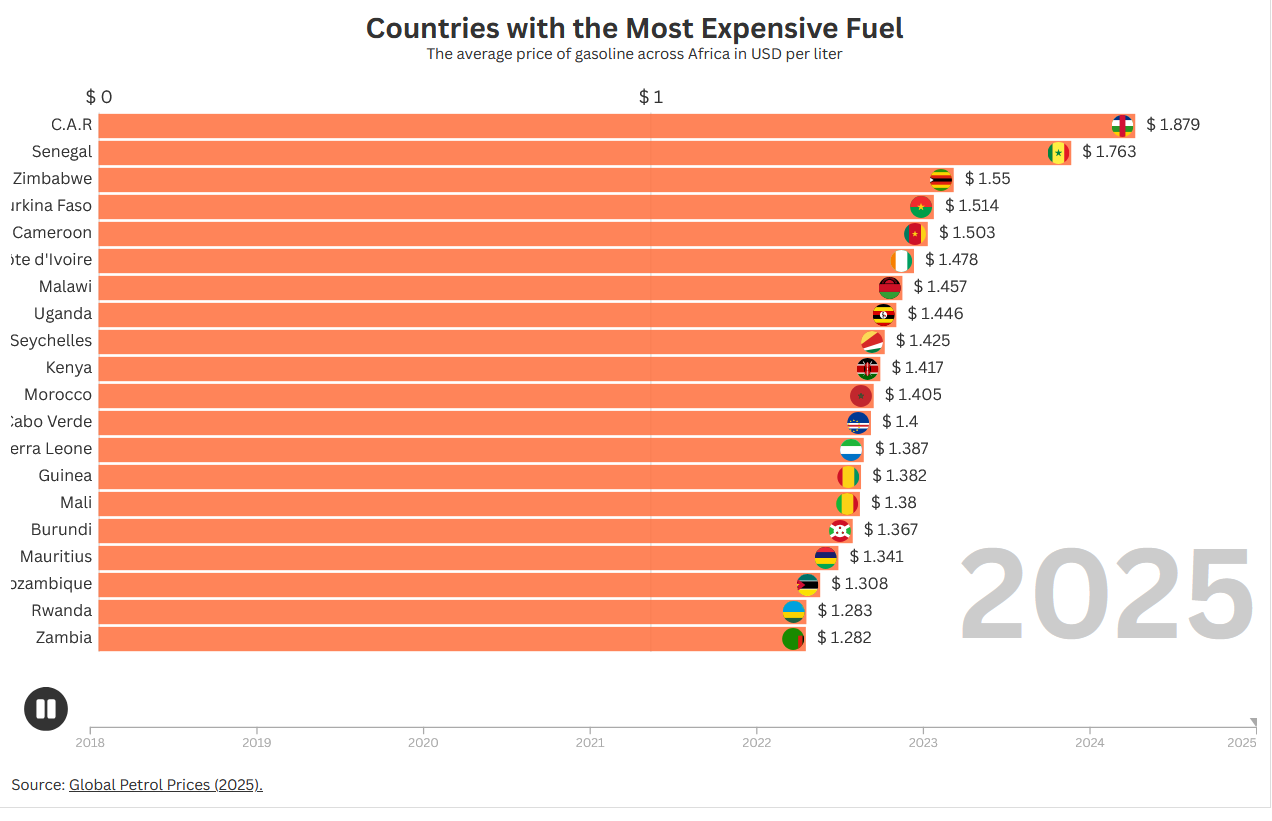
Countries like the Central African Republic, Senegal, and Zimbabwe experience some of the highest petrol prices on the continent. In September 2025, the Central African Republic's fuel price stood at $1.765 per liter, Senegal's at $1.589, and Zimbabwe's at $1.480 in 2025.
https://public.flourish.studio/visualisation/25542350/
Landlocked or politically unstable nations pay the highest prices. The Central African Republic consistently ranks among the most expensive, reaching $2.14 in 2020. Zimbabwe remains high at $1.03-$1.55, while Burundi, Mali, and Uganda all face steep costs due to geography and weak infrastructure.
The Global Effect on Price
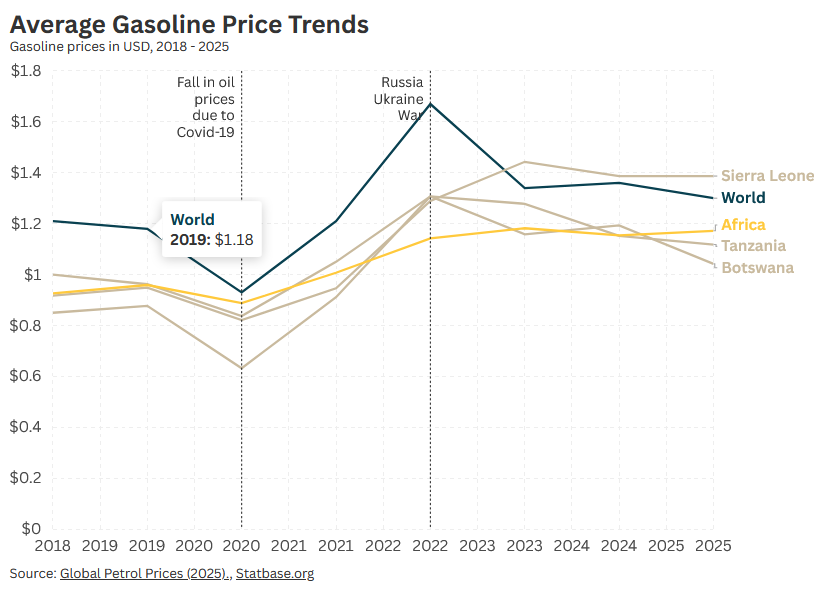
Global events tend to affect prices positively and negatively. The COVID-19 pandemic, for example, caused widespread price drops in 2020.
Prices in Botswana fell 28% from $0.88 to $0.63, Tanzania dropped 13% to $0.84, and South Africa decreased 11% to $0.92, reflecting the global oil price collapse. Post-pandemic however, prices shot up. In 2021-2022. Botswana doubled its price to $1.31, Tanzania rose 56% to $1.31, and Sierra Leone increased 57% to $1.29. By 2023-2025, most countries show stabilization or slight decreases, signaling recovery from the post-pandemic surge.
https://public.flourish.studio/visualisation/25628138/
North Africa Enjoys Lower Prices than Other Regions
North African nations—Libya, Algeria, Egypt, and Tunisia—benefit from oil production and proximity to Middle Eastern supply, keeping prices low. Southern Africa, including Botswana, Namibia, and South Africa, sits in the mid-range, with good infrastructure but import dependence. Central and East African countries, such as the CAR, Burundi, Uganda, and Rwanda, face the highest prices due to being landlocked, weak infrastructure and reliance on imports.
Sudan’s Prices Have Fluctuated The Most Between 2018 and 2025
Sudan stands out with extreme volatility: prices started at $0.21 per liter in 2018, dropped to $0.09 in 2019, then surged to $1.32 in 2022, before settling at $0.70 in 2025. This is a fourteen-fold increase from its lowest to highest point. Egypt shows similar fluctuations, peaking at $0.57 in 2020-2021, falling to $0.31 in 2024, and rising slightly to $0.40 in 2025.
Algeria’s prices only vary between $0.31 and $0.36 over eight years. Morocco remains between $1.00 and $1.42, while Mauritius ranges $1.08-$1.47. Meanwhile, the biggest movers show total changes of 50% or more.
About the Data
The article is based on a dataset compiled from Global Petrol Prices which tracks gasoline prices for 41 African countries spanning eight years from 2018 to 2025. Some countries have incomplete data for certain years due to reporting gaps or political instability. Find the clean full dataset here
Cover Photo by Jonathan Petersson on Unsplash
.jpg)


