-p-1080.jpg)
.jpg)
For nearly two decades, international tourism in Africa grew steadily. Countries across the continent, from Morocco’s medinas to Namibia’s desert, welcomed millions of travelers each year.
Between 2010 and 2019, tourism surged. Morocco doubled its international arrivals from 9.3 million to over 13 million. Egypt bounced back from the Arab Spring to reach 13 million visitors while Ethiopia’s arrivals nearly doubled, rising from approximately 400,000 in 2010 to around 900,000 by 2019. Cabo Verde on the other hand more than doubled its visitors to 819,000.
Nigeria, despite its size and cultural wealth, fell from 6.1 million arrivals in 2010 to 2.1 million in 2019, as insecurity and infrastructure challenges discouraged travelers.
The COVID-19 Ages
The COVID-19 pandemic brought this momentum to a sudden halt in 2020. Border closures and travel restrictions caused arrivals to drop by more than 70 percent in many countries, erasing years of progress almost overnight.
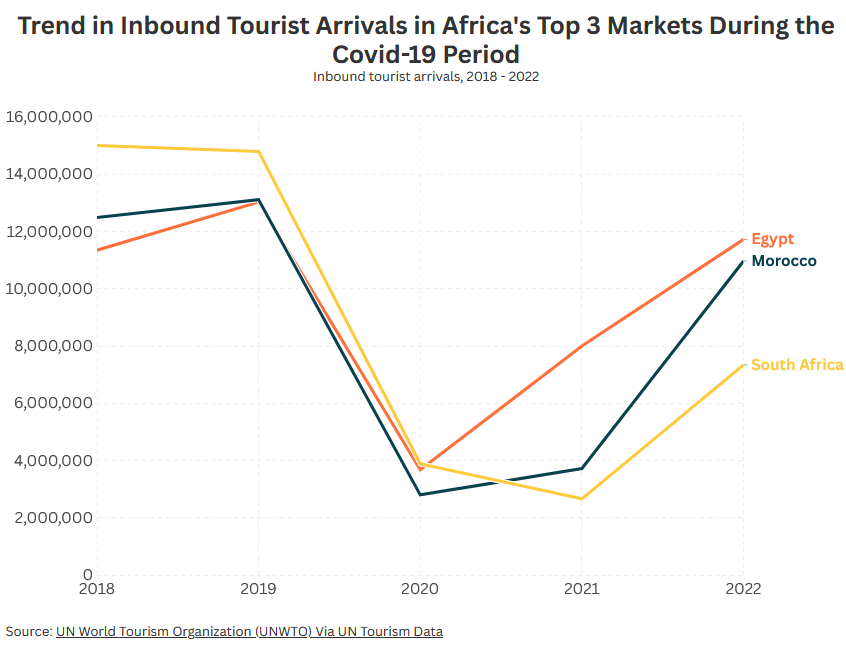
By 2022, tourism began to recover but unevenly. Morocco welcomed 10.9 million visitors, nearly back to pre-pandemic levels, while Egypt reached 11.7 million.
Other nations lagged. Namibia and Mozambique recovered only a fraction of their 2019 numbers, slowed by dependence on regional travelers, particularly from South Africa, whose economy has struggled.
Countries like Côte d’Ivoire not only recovered from the pandemic but also exceeded their pre-2019 tourist numbers. Côte d’Ivoire welcomed 72 percent more visitors in 2022 than in 2019. Senegal followed closely, attracting 59 percent more tourists and nearly doubling its pre-pandemic arrivals. Zimbabwe also stands out in Southern Africa, with a 42 percent increase over 2019 levels.
North Africa Top Tourist Destination
North Africa leads, with Morocco and Egypt drawing more visitors individually than many entire regions of Sub-Saharan Africa.
Countries affected by conflict—such as the Central African Republic, Chad, and Mali—see some of the continent’s lowest visitor numbers, as insecurity continues to block tourism growth.
Regional travel also plays an important role; in places like Eswatini, same-day visitors from neighboring countries make up a large share of total arrivals, highlighting the reliance on nearby markets rather than long-haul international travelers.
About the Data
The analysis uses data from the United Nations World Tourism Organization (UNWTO) on inbound tourist arrivals to African countries. It covers annual figures from 1995 to 2022. Find the clean full dataset here
Cover Photo by Ross Parmly on Unsplash